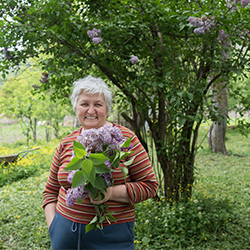
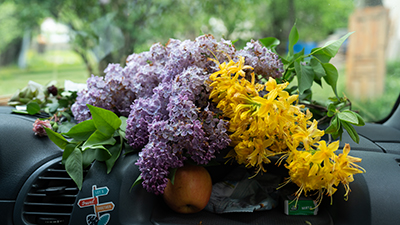
Moving on from Latali and Nino’s generous hospitality was difficult as she had spent so much time making us welcome and explaining her ideas about ways in which the Svan traditions could be passed on to future generations and be understood by the other regions of Georgia, too. Nor would she accept payment for anything we had received AND we left with the front of the van smelling of lilac!
For some reason, I hadn’t realised how short the drive from Latali to Mestia would be and settled in comfortably for at least an hour, only to find we were there in just a few minutes. Even in that short distance though I was able to see how significant the ‘Svan towers’ have been in the area’s history and tradition.
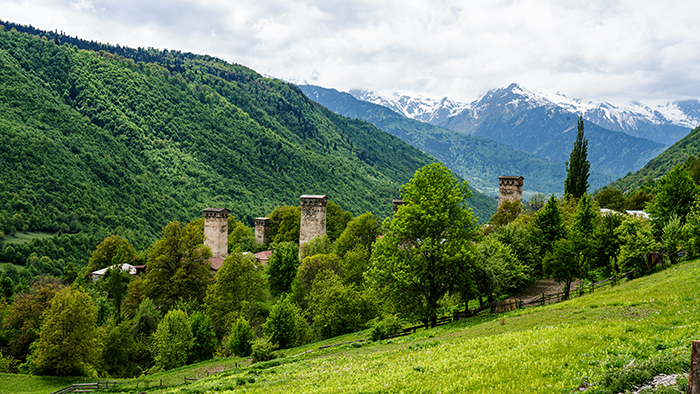
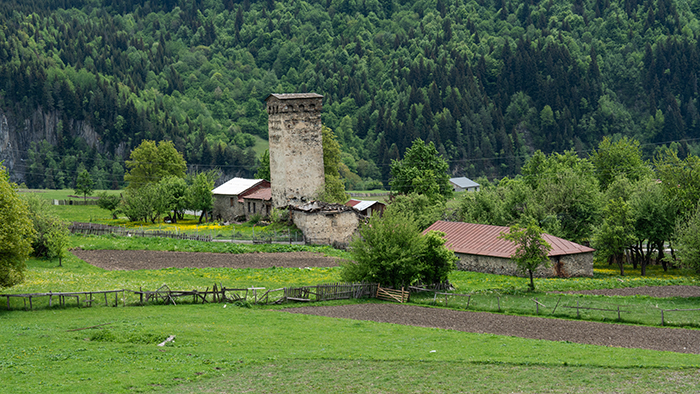
Scenes like these prepared me a little for what we were to hear at the Museum where we were shown around by one of the staff whose English is really good and who understood the exhibits really well.
For me the key information was that Svaneti would never be enforced to succumb to a foreign power. They were proud and free, so were good defenders of not only the area but also the country’s boundaries. The towers were key in enabling them to protect local treasures: these were secure in the upper floors of the towers while the family lived in its base. Totally unassailable!
The riches of even a little village like Latali were incredible – and all saved because individual families made sure they were safe in the towers when invaders approached.
We could also see at the museum that this was a cultured people, particularly with regard to their musical traditions and their iconography. There were some beautiful examples including the earliest example of illuminated manuscript to survive. Known as the Adishi Four Gospels it dates back to 897 A.D

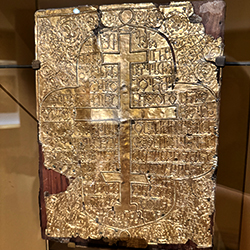
And there was a range of art work – icons dating from very early Christianity through to the Eighteenth Century and from different schools of art.
All too soon, we were off to the hotel, but first we were both in need of food so went in search of the chicken in creamy garlic sauce that Tako had enjoyed on her last visit.. and then there was time to catch up on actually chatting about where we had been, what we had done, what needs to be done and even to share some photographs in the warmth of a cosy hotel room.
The plans that we had had for activities were a bit curtailed here: partly because of the weekend, but more significantly because there had been a road accident in which three of the young people from the area had been killed. The whole area was in mourning and there was to be no lively music or performance during the week.
We didn’t miss out totally, though. We enjoyed a leisurely Sunday morning before going to find some local points of interest, including the ‘house museum’ of Mikheil Khergiani, a renowned alpine climber who was born here and who was apparently given the title ‘Tiger of the Rocks’ in the UK. (The information in the museum indicates the name came from the late Queen but there’s nothing to suggest that was the case in Wikipedia or any other site I could find). We were shown around by a descendant who looked very like the great man. And here was another example of how the whole of this region is tied up with its Russian past: Mikheil Khargiani was born in the United Soviet State of Georgia and the name by which he is best known is his Russian name. He was USSR Climbing Champion a number of times.

The current generation of the family is still really proud not only of what Mikheil achieved but also of the home in which he grew up with its very ancient walls, furniture and decoration. I think I remember correctly that the earliest parts of the house date to about 9th Century. They are amazingly detailed .
Having exhausted the views on our side of the river we decided to go across the bridge and see what kind of view we could find to enjoy while we indulged in one of Tako’s special coffees from the van.
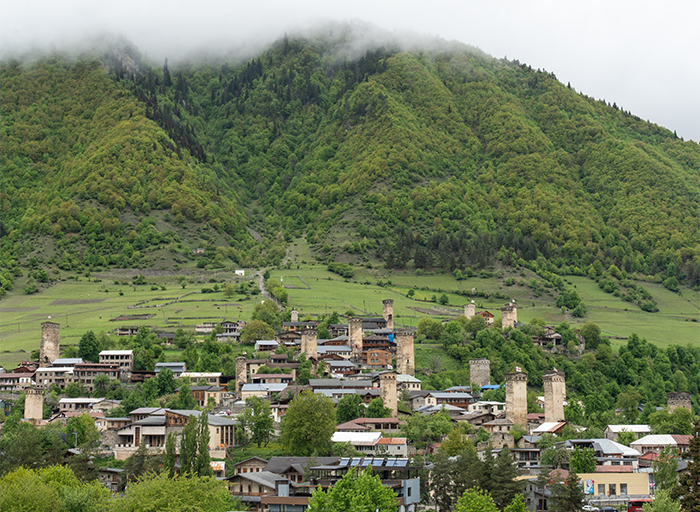
We succeeded! And I was reminded what a small community this is. It was quiet during our visit but I can only imagine what it’s like when hordes of skiers arrive in winter. I bet the locals just want to run away!!
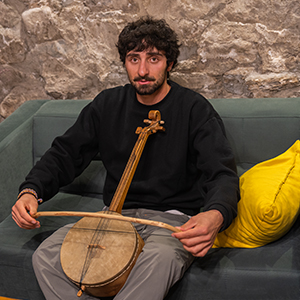
That evening we were expecting to meet a young man called Beshken Pilpani who is a local ski instructor and mountain guide but whose passion is playing an ancient stringed instrument – the chuniri.
Beshken’s father is leader of a local folk group and his grandfather was renowned for playing the chuniri Beshken has now taken up. This young man is an example to all: keen to explain his instrument and his art to help us understand the musical tradition of Svaneti. And he came to meet us after a whole day family event. He’s just twenty-one. I love the look of shyness in front of the camera yet ease with the chuniri in this image.
Mestia is our furthest point from Tbilisi, so the time has come to wend our way back to the capital, to see what the situation is regarding the political differences appearing in the country and to do some final sight-seeing and maybe some shopping before I have to leave this proud, welcoming little country.
 Living the Journey
what an amazing country. Both beautiful and culturally rich in it’s history. Thank you for sharing.
Happy birthday!!
Kath, – you are so lucky, we know you have seen a lot of the world, but surely this experience must be something quite magical!
Best wishes,
Mike & Jenny
Thank you Kath for sharing this wonderful journey with me what a wonderful experience J envy x
Sent from my iPad
>